Current affairs · Eurostat · population ageing
Europe has never been older: EU median age reaches 44.9 years
Eurostat’s Demography of Europe 2026 highlights one of Europe’s most important long-term demographic shifts: the population of the European Union is older than ever before.
July 2026 · IDP Analysis
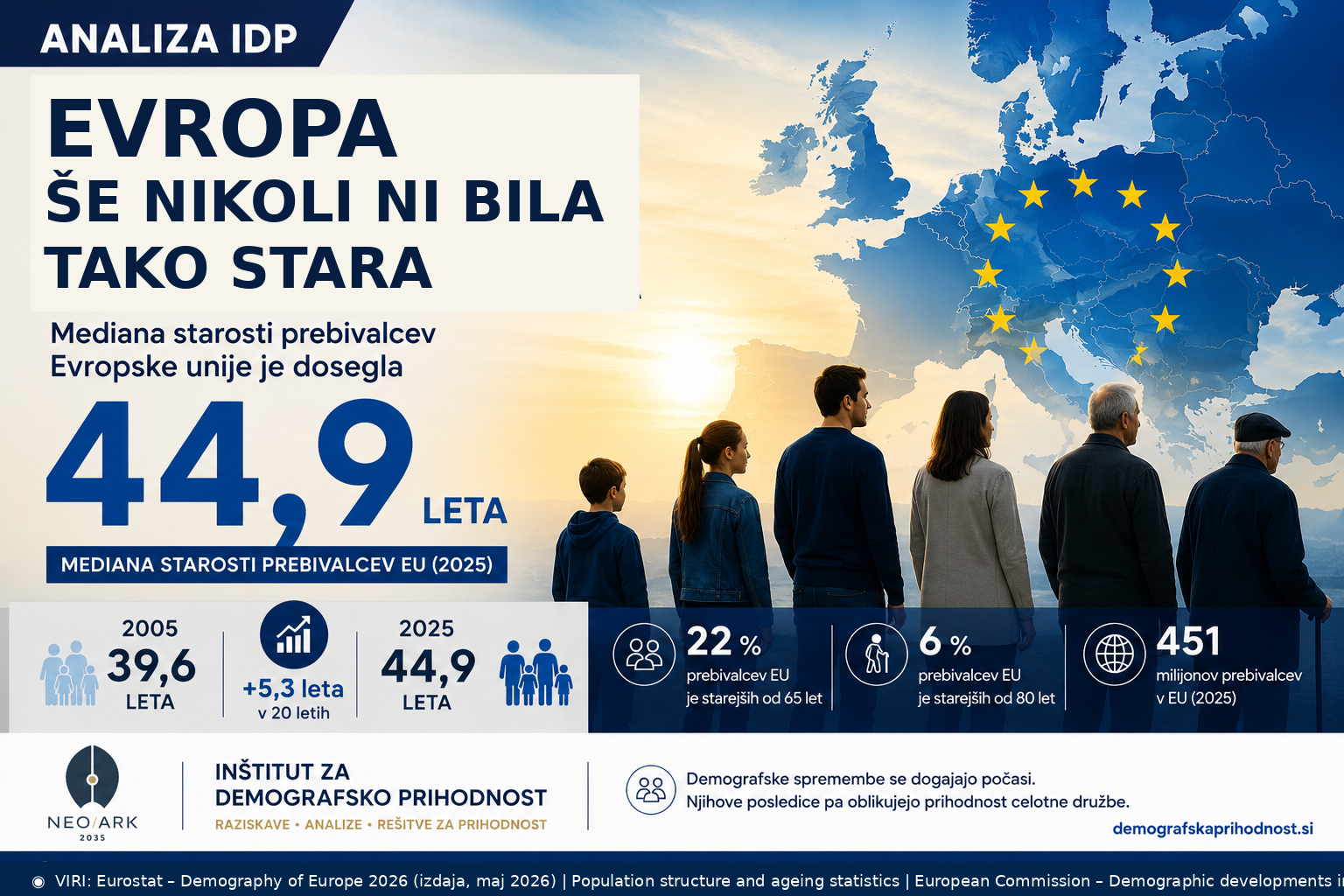
The figure 44.9 is not just a statistic. It is a signal of Europe’s future structure.
Median age of the European Union population on 1 January 2025.
Increase compared with 2005, when the EU median age was 39.6 years.
Share of EU residents aged 65 or over.
Demographic change happens slowly, but its consequences shape labour markets, healthcare, pensions, housing, education and local development.
Eurostat has published a new demographic portrait of Europe.
Eurostat’s Demography of Europe 2026 brings together the latest key data on the population of the European Union. One of the most significant indicators is that the median age of the EU population reached 44.9 years.
Eurostat notes that the median age was 39.6 years in 2005, which means it increased by more than five years over two decades. In 2025, the EU was home to around 451 million people, while around 6% of the population was aged 80 or over.
The figure matters because it shows how the balance between generations is changing. It is not only a measure of age, but a signal of future social, economic and institutional pressure.
The median divides the population into two equal halves.
Median age means that half of the population is younger and half is older than that age. It is different from the average age, which can be influenced by extreme values.
When the EU median age is 44.9 years, this means that half of the EU population is younger than 44.9 and half is older. As the median rises, the age structure of the entire population is shifting.
Population ageing is not a problem because people live longer. The challenge is whether systems adapt quickly enough.
Longer life expectancy is one of the greatest achievements of modern societies. The challenge emerges when the balance between younger, working-age and older generations changes faster than economies, public policies and local communities can adapt.
A higher median age affects labour markets, healthcare, long-term care, pension systems and local development. It also changes the way municipalities plan public services, housing, transport and social infrastructure.
Slovenia should treat ageing as a development issue, not merely as a statistical note.
Slovenia is part of the same European demographic trend. The population is ageing, the share of older residents is rising, and fertility remains below the level needed for simple long-term generational replacement without migration and other demographic factors.
This means that future decisions on labour markets, healthcare, long-term care, pensions, housing, education, family policy and regional development will increasingly need to take demographic realities into account.
Median age is one of the clearest indicators of Europe’s demographic transformation.
According to the Institute for Demographic Future, the median age is not merely a statistical detail. It is a key indicator for understanding how European society is changing and what kind of long-term decisions will be required.
Population ageing is not a problem in itself. The real challenge begins when institutions, economies, public systems and local communities adapt too slowly to demographic change. Demography does not determine the future, but it helps us understand it in time.
Can European countries adapt to population ageing faster than their age structures are changing?
Understanding demographic trends is the first step towards responsible planning for the future.
Sources: Eurostat – Demography of Europe 2026; Eurostat – Population structure and ageing; European Commission – demographic developments in Europe.
Back to Current Affairs