1. Introduction
Debates about Europe’s demographic future usually focus on fertility and population ageing. Yet demographic change is not reflected only in birth numbers. It is increasingly visible in how people live, form partnerships and establish households.
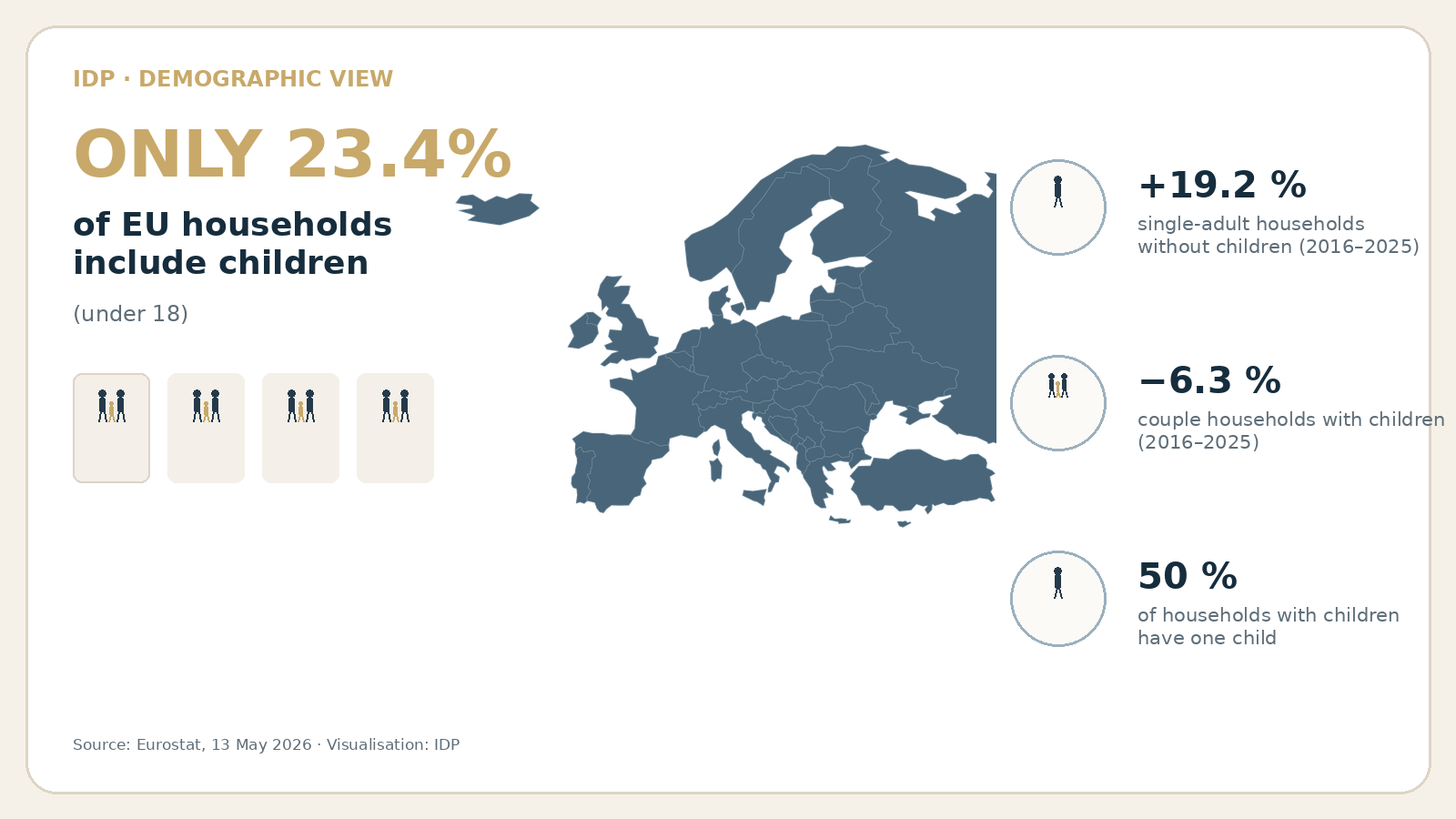
Eurostat recorded 203.1 million households in the European Union in 2025. Only 47.4 million, or 23.4%, included children under the age of 18. More than three quarters of all EU households therefore had no resident children.
Where is reproductive time going?
The study examines the interval between leaving the parental home and the birth of a first child, showing how delayed transitions can compress the time available to realise family intentions.
Read the researchBetween 2016 and 2025, single-adult households without children increased from 63.9 to 76.1 million, while couple households with children declined from 31.9 to 29.9 million. Half of all households with children had only one child.
What do the European data show?
The figure does not mean that every childless household is a consequence of low fertility. The category includes older couples, households whose adult children have moved out, young adults before family formation and many other living arrangements. Nevertheless, the sustained growth of single-adult households and the decline in couple households with children point to a significant transformation of the European life course.
Research by the European Commission’s Joint Research Centre has highlighted how constrained housing access, later departure from the parental home and rising housing costs can delay independent household formation and childbearing. Household structure is therefore linked to housing, employment security and the wider conditions under which young adults become independent.
Analysis by the Institute for Demographic Future
The Institute for Demographic Future considers fertility to be the final link in a longer chain of life-course events. Before a child is born, individuals commonly complete education, enter employment, achieve financial independence, secure housing, form a stable partnership and establish their own household.
When one transition is delayed, subsequent transitions may also be postponed. The declining share of households with children is therefore not merely a family statistic; it is also an indicator of a changing life course.
What does this mean for Slovenia?
Slovenia faces low fertility, population ageing and relatively late departure from the parental home. IDP research found that the interval between residential independence and first parenthood is comparatively short, meaning that several major transitions must take place within a limited period.
If demographic policy focuses only on annual birth numbers, intervention begins only after the consequences are visible. Slovenia should also monitor the age of residential independence, housing access, employment security, partnership formation, time to first birth and the gap between desired and achieved family size.
Conclusion
The fact that children live in only around one quarter of EU households is not, by itself, proof of the causes of low fertility. It is, however, an important indicator of wider changes in European living arrangements.
Demographic change does not begin only when fewer children are born. It begins earlier — in young adults’ opportunities to become independent, access housing, form stable partnerships and establish families. Effective demographic policy therefore requires coordinated housing, employment, family and development policies.
Eurostat, 23.4% of EU households had children in 2025, 13 May 2026. In the statistics used, a child is defined as a household member under the age of 18. Data derive from the EU Labour Force Survey.
European Commission Joint Research Centre, analysis of housing needs and links between delayed household formation and childbearing, 16 December 2025.
Institute for Demographic Future, Where is reproductive time going?
This analysis is based on publicly available data from European institutions and research conducted by the Institute for Demographic Future.