Current · Eurostat · Demography of Europe
Eurostat publishes Demography of Europe 2026
Europe gains a clearer picture of its demographic future.
Ljubljana, July 2026 · Research note
Demographic change does not happen overnight.
It develops gradually, but over time it affects almost every part of society – from the economy and labour market to healthcare, pensions, housing policy and the development of local communities.
This is why Eurostat’s new interactive publication, Demography of Europe 2026, is an important resource for anyone seeking to understand how Europe’s population is changing and what these processes may mean for the future. The publication brings together recent data on population structure, fertility, migration, life expectancy, marital status and other key demographic indicators, while enabling comparisons between EU Member States over time.
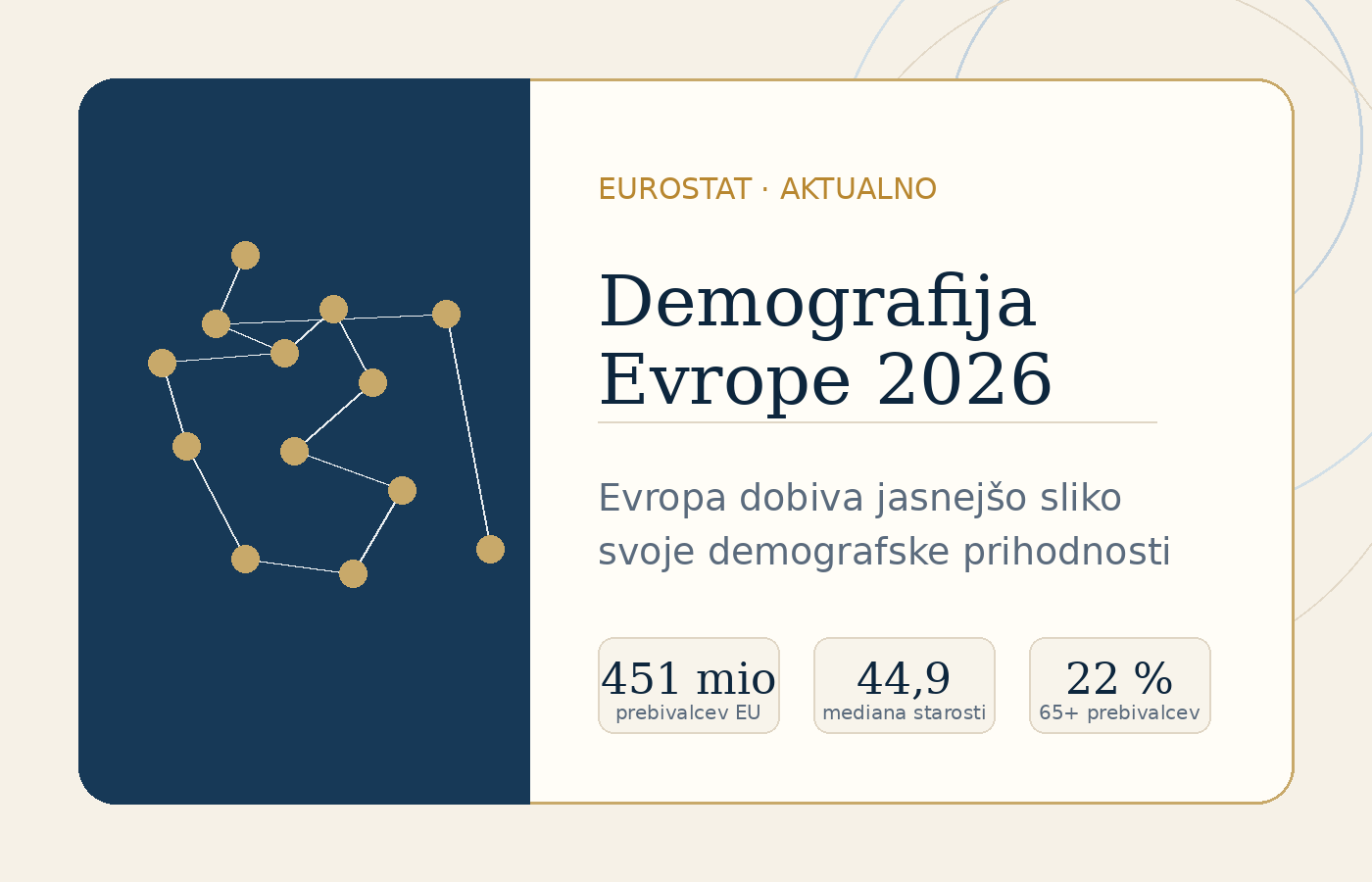
The European Union has around 451 million people, but its age structure continues to change.
According to Eurostat, around 451 million people lived in the European Union on 1 January 2025, about one million more than a year earlier. Despite this modest population increase, the data show that the age structure of European society continues to shift.
The publication also shows that Europe is not demographically uniform. Some countries have substantially older populations, while others maintain a younger age structure because of higher fertility, migration or both. These differences directly affect national needs and the design of public policy.
Demographic data are not just statistics. They are a foundation for understanding social development.
When the age structure of a population changes, so do the needs for childcare, schools, healthcare, long-term care, housing, public transport and labour-market policy. Demographic indicators therefore influence decisions taken by governments, municipalities, businesses and public institutions.
Eurostat’s publication makes it possible to follow these developments through comparable and internationally harmonised data. It is therefore an important basis for long-term planning at both EU and Member State level.
The publication matters because it moves demography beyond isolated figures and towards a broader understanding of long-term social consequences.
Slovenia is part of the same long-term demographic processes as much of Europe.
Slovenia faces similar demographic trends to many other European countries. The share of older people is increasing, fertility remains below the level required for simple population replacement, and the average age of the population is rising.
This means that intergenerational solidarity, access to healthcare, the development of long-term care, the labour market and the conditions for family life will remain among Slovenia’s key development challenges in the years ahead.
Comparisons with other countries can help Slovenia better understand its own position and contribute to the preparation of long-term development strategies.
The publication’s greatest value lies in presenting demography as an interconnected system.
In the view of the Institute for Demographic Future, the main value of Demography of Europe 2026 is that it presents demographic trends as interconnected processes rather than as isolated statistical indicators.
Public debate on demography often remains focused on fertility or population ageing. Eurostat’s publication shows more clearly that the future of European societies is shaped by the interaction of several factors – age structure, migration, family change, population mobility and longer life expectancy.
Effective planning for the future therefore requires more than individual measures or short-term responses. It requires a long-term, data-based understanding of demographic processes and cooperation across different areas of public policy. This is the foundation of responsible demographic planning.
Eurostat
Source: Eurostat – Demography of Europe: 2026 edition.
Read more analytical updates
The Current section of the Institute for Demographic Future explains what major demographic developments mean for Slovenia and Europe.
Europe’s demographic future is not a distant issue. It is already taking shape.
Eurostat’s data are an important starting point, but their real value emerges when they are connected to long-term social planning.
Back to Current